a sleepy, dying President
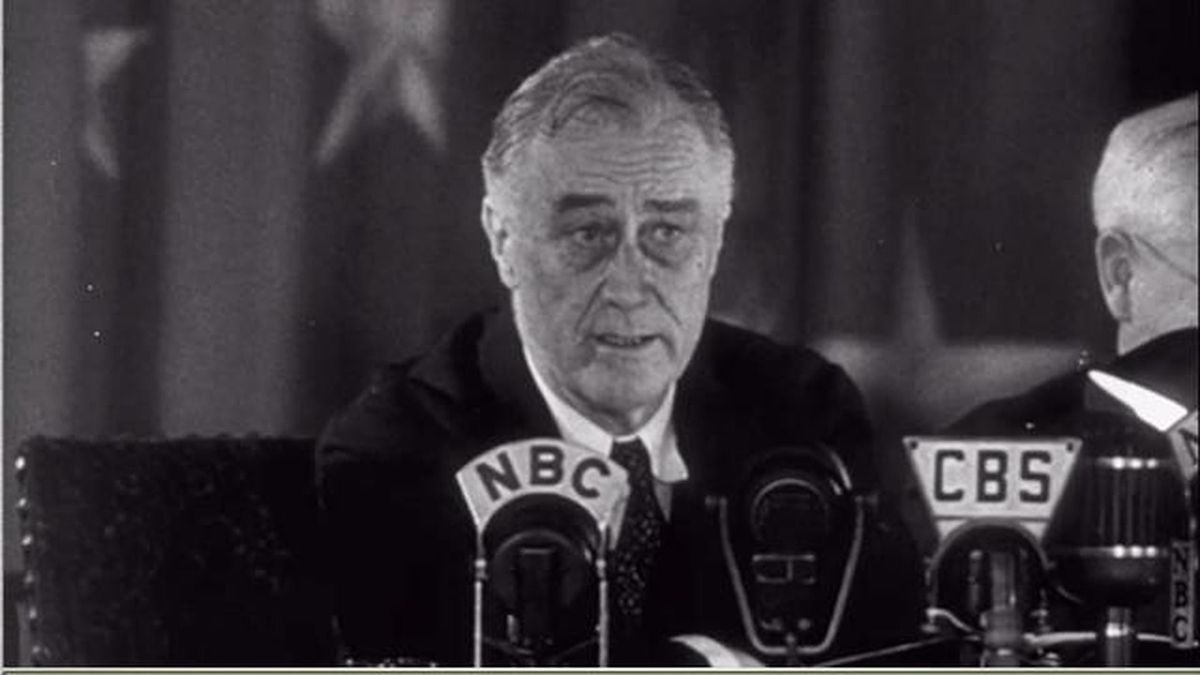
I recently picked up the book "The Dying President". It was just sitting in the library.
Franklin D. Roosevelt had been president since March 1933 and was still president eleven years later. There was an unofficial precedent where no one had served more than two terms, but as 1940 was coming around, Europe was at war, and the U.S. was taking sides in the war and so pretty likely to join eventually. Also the Democratic party of the early 20th century was a bizarre mashup of a workers/egalitarian type of party that produced the New Deal and also the southerners for whom "Democrat" meant "not those Republicans who beat us in the Civil War." In maximizing the size of the tent at the 1932 and 1936 conventions, Roosevelt was stuck with a Texas conservative for a running mate, but as 1940 came around and that guy expected that it was his turn, Roosevelt decided it was easier to stay in the job than try to find a better replacement than himself to keep the factions together. He chose a more thematically appropriate VP for the third time around (Henry Wallace), won a third term, and then the US joined the war in December 1941.
So in some of the messiest days of the war, as the US is preparing to invade Europe and create a Western Front, Roosevelt is visibly in terrible shape, and his doctors and handlers are focusing on keeping this information hidden from the public (it could be bad for morale / the war effort). Much like other presidents who met an early end in the 19th century because doctors didn't believe in hand-washing, Roosevelt was being misdiagnosed. His daughter Anna intervened to have him examined by another doctor, who on March 28, 1944 at last diagnosed that he was dying of heart failure.
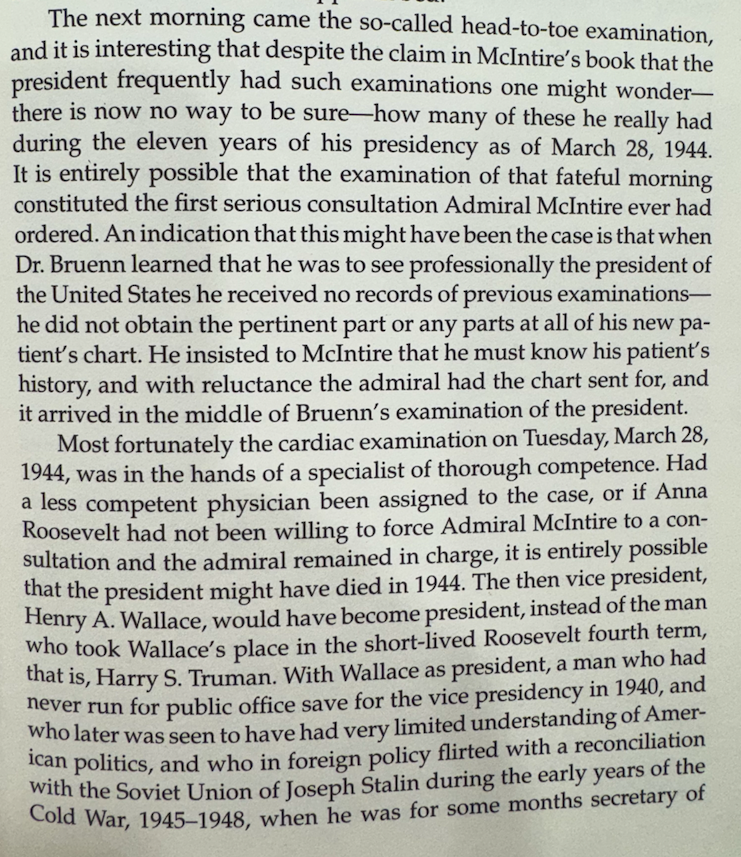
Some of the striking details of the book are the advances in medicine that remain within living memory. The field of "cardiology" was practically a new thing at the time. But luckily for Roosevelt he had been given one, and it saw him through one more election. Was this good or bad? We can try to imagine him resigning and giving power over to Wallace, which would have alarmed all the Democrats who hated Wallace and successfully schemed to get him off the ticket in 1944. Or he could have simply pledged to serve out his term until January 1945 but not to run for election in 1944. Who might have won an open primary in 1944 during the war? Could Roosevelt have anointed someone? In 1948 when Truman ran for election after having served most of the fourth term that Roosevelt died a few months into, there was a version of the inter-party fight that could have happened instead in 1944. Wallace representing the progressive side of the party, Truman the center, and Strom Thurmond the conservatives, split the party three ways, creating a four-candidate election between three Democrats and one Republican. While in 1860 bickering Democrats doing this elected the Republican, Lincoln, when the Democrats split and a third party formed for a one-off ex-Whig, somehow in 1948 this didn't tank Truman's reelection. The civil-rights split of 1948 would probably have been tamped down four years earlier, for a wartime convention, but there would had to have been a compromise candidate that each side could stomach. And since it didn't happen it's tough to definitively say who that could have been. If Roosevelt had enough power left to crown Wallace, he would also have had enough power to stay in the job himself, right? If Roosevelt had died in April 1944, would the segregationists that summer have grit their teeth and supported Wallace, who refused to speak to segregated audiences?
But instead, we got what we got. A very sleepy president, staying in bed most of the morning, then working 2-4 hours a day in between naps.
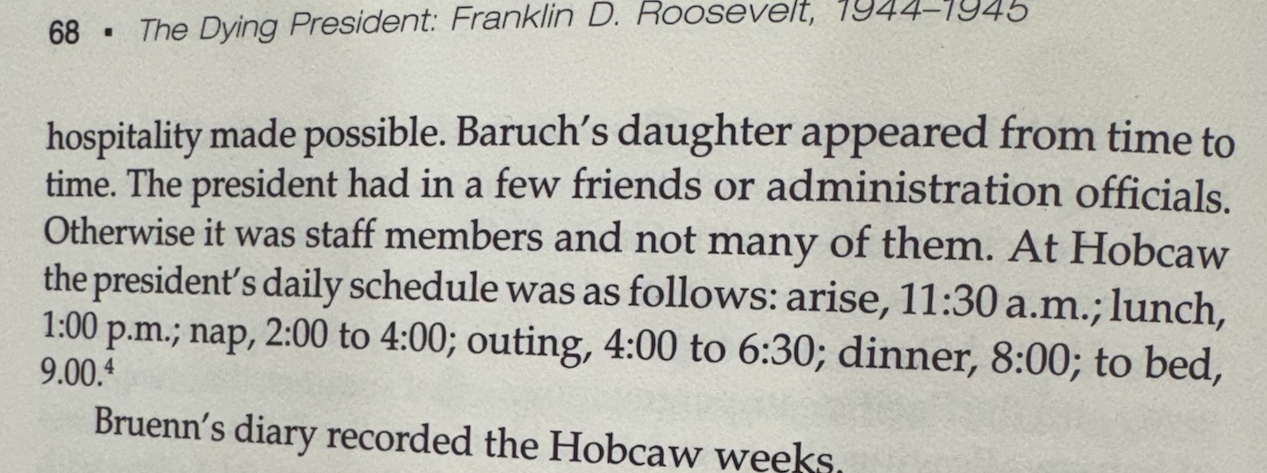
"Hobcaw" refers to a place in South Carolina he went on vacation for a month in April/May, trying to get his health back. He was absent from the White House 175 days in 1944:
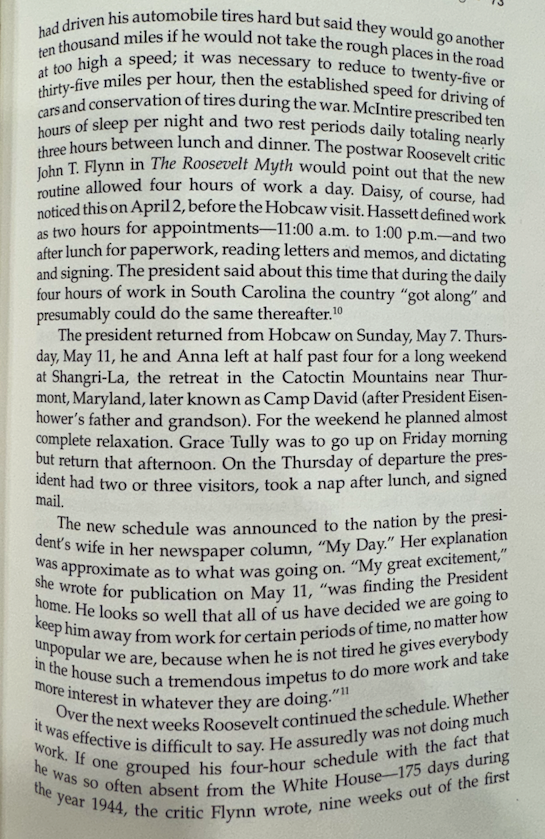
But by the end, the methods employed by his cardiologist and his handlers kept him going long enough to survive through the election, although not to the end of the war, even the one in Europe. Hitler in the bunker outlived him by a few weeks.
Writing in the 90s, Ferrell speculates about the perks of staying in office past your physical capacities in terms that bring to mind the geriatric officeholders of today. In a virtuous circle, the handlers enjoy their boss's decline because it gives them more power than they had when he was more capable. The boss enjoys what power he has left, and has only the silence of the nursing home to look forward to if he gives that up.
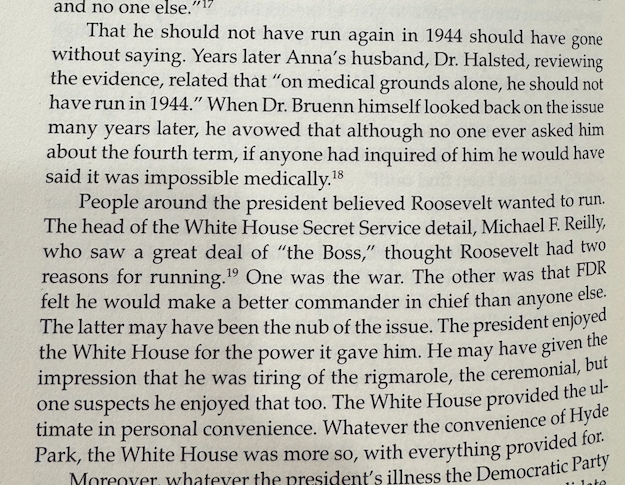
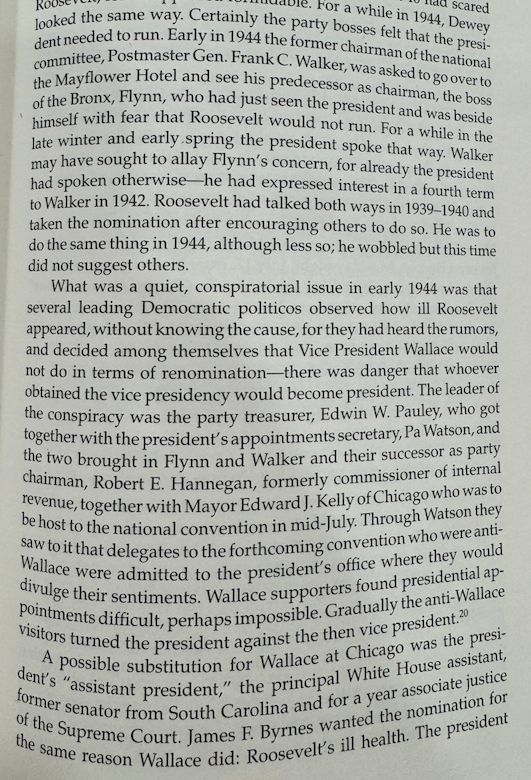
The party leaders preferred that he stay on because they felt that he gave them the best chance of winning, with all the jobs that gives them for four more years. They observed his illness and preferred to do their maneuvering behind the scenes instead of speaking publicly about what they knew. That's why they focused on replacing Wallace as VP, assuming that their choice would end up President anyway sometime during that term (and they turned out to be right). And ambitious men angled for the vice presidency (mostly a bum job), recognizing the same thing. Like becoming Baltimore mayor because your predecessor committed a crime and had to resign, instead of running for mayor yourself, it's an easier way to get the job you want.
Sooner after the convention where Truman is the new VP choice, FDR is headed to Hawaii to talk over the Pacific War. Ferrell is particularly incensed that after a lengthy voyage, he speaks to the general/admirals for only 2.5 hour session.
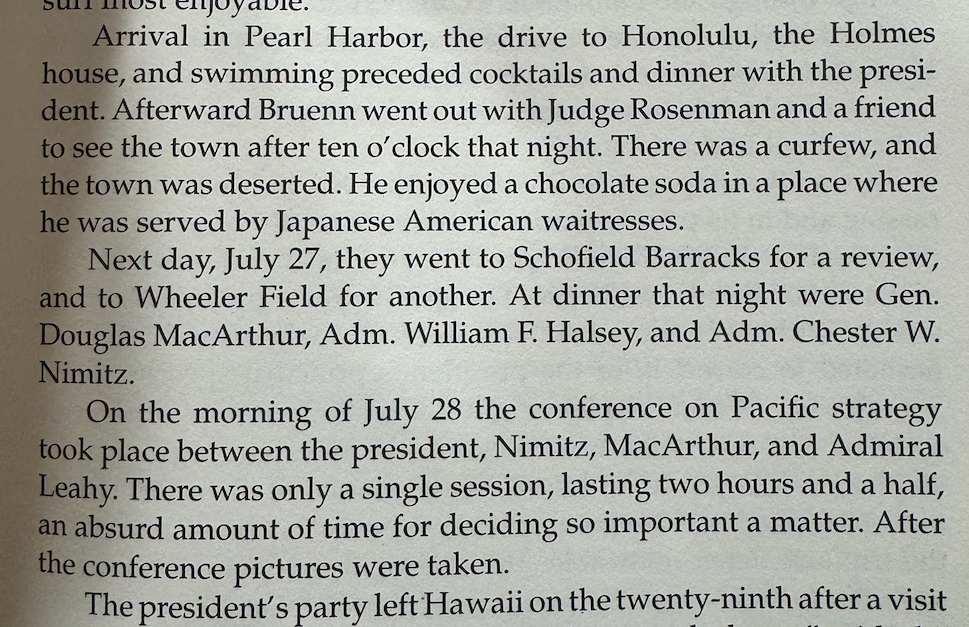
He goes into speculations about how defeating Japan could have gone better, which I'm not into that type of stuff enough to try to parse, but it seems plausible enough that all the lives that went into taking tiny islands like Peleliu and Iwo Jima need not have been thrown away.
But he survives the election, including campaigning in northeastern cities during a rainstorm. That winter, he travels across Europe under guard to meet Stalin and Churchill together for the second and final time, at Yalta (Crimea).
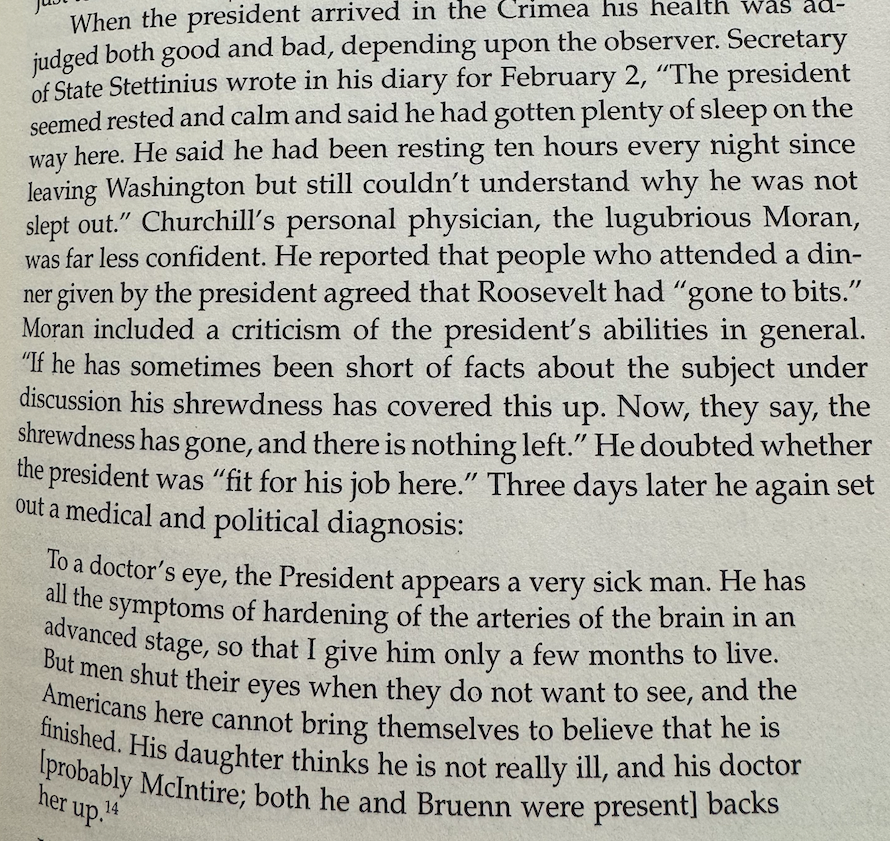
Ferrell takes a typical US-centric dim view of the need for the Soviets to join the war against Japan. Hey, they only joined the war for a few weeks, and we dropped the nukes, so we didn't really need them anyway, huh?
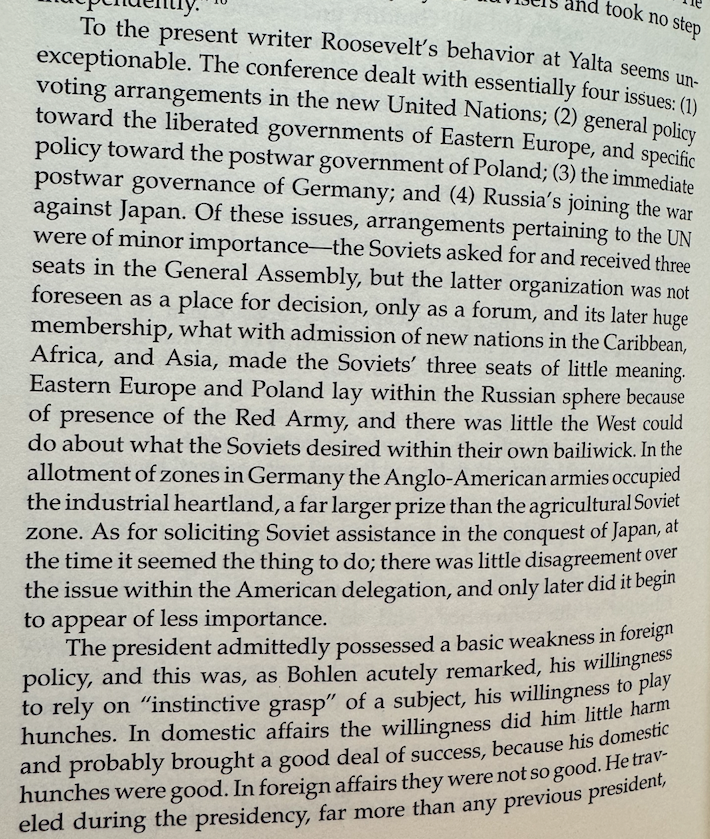
I've been annoyed by this line of thinking ever since reading Matthew Stevenson in Harper's (in the course of taking on Bill O'Reilly's "Killing Stuff" history series) on the importance of the Soviet-Japan war.
The biggest problem I have with O’Reilly and Dugard’s conclusions about the Pacific war is that they make the leap to nuclear faith without ever exploring any of the alternatives. They draw a line between the barbarity of the Imperial Japanese Army, especially in China and on various Pacific islands, and the necessity of dropping the bombs, which, they announce, both won the war and were just: Case closed.
After Franklin Roosevelt had commissioned the construction of the bombs, no one in the chain of command, including his successor, Harry Truman, objected to their use against the Japanese. The bombs rolled off the production line and into the cargo bays of the B-29s with few questions asked about their truths or consequences. But there is abundant scholarship that the Japanese did not surrender because of the bombs—merely that they surrendered around the time that the bombs fell, giving postwar Americans (so dependent on air power) the convenient connection between Hiroshima and Nagasaki and victory, although in my view the Pacific war dragged on until 1949, when the Nationalist Chinese fled to Taiwan.
It took me a long time even to consider that the bombs did not end the war or that America could well have defeated Japan without a large-scale amphibious landing. The person who had the greatest influence in changing my thinking was my friend Murray Sayle, the foreign correspondent who spent much of his adult life living in Japan and studying the effects of the atomic bombs.
Having read the 1945 Japanese cabinet’s deliberations regarding surrender and the reactions of the Imperial Japanese Army to the atomic bombs and the earlier firebombing of Tokyo, Sayle came to the conclusion that Japan feared a Russian-induced partition much more than it cared about the death of Korean guest workers in Nagasaki or the loss of the red-light district in Hiroshima. Japan had seen how the Russians and Americans had divided Germany into spheres of influence, and the cabinet feared the same would happen to them if the Russians were allowed to march through Manchuria and Korea.
When O’Reilly and Dugard mention the Soviet entrance into the war against Japan, it is to imply that the red devil Stalin was pulling a fast one on his Western allies, trying to snatch as much of Manchuria as his troops could conquer. But whether or not you like what happened at Yalta, Roosevelt’s principal aim there was to persuade the Soviets to enter the war against the Japanese. On this point, perhaps because it suited his geopolitical ambitions, Stalin agreed, and by August his armies were getting close to the home islands. Sayle’s work also led him to the conclusion that the Japanese were prepared to surrender (provided they could keep the emperor on the throne) early in the summer of 1945, well before the bombs fell.
To the end of his life, Sayle never could see a connection between the bombs and the Japanese surrender. In 1995, he published an essay for The New Yorker entitled “Did the Bomb End the War?,” in which he writes:
"The sequence of events—Hiroshima, Nagasaki, surrender offer—is striking. Could it be that pure coincidence has clouded our understanding of the surrender for half a century? Indeed it could. By themselves, the dates prove nothing.”
His argument, borne out by the Cold War, was that the Japanese high command surrendered because it believed that the country could survive only if it was protected from the Russian advance by the Americans. The losses in Hiroshima and Nagasaki did not play a large part in that equation. As he would say often when we would drive together around Japan, visiting the atomic and other World War II sites: “If there is such a process as military leaders being cowed into submission by air attacks, nuclear or otherwise, history has no clear example of it.”
But by the time the Russians kept their promise and invaded, and the U.S. took the credit instead by dropping the nukes, Roosevelt had died. He went on one last vacation, dying in Georgia.
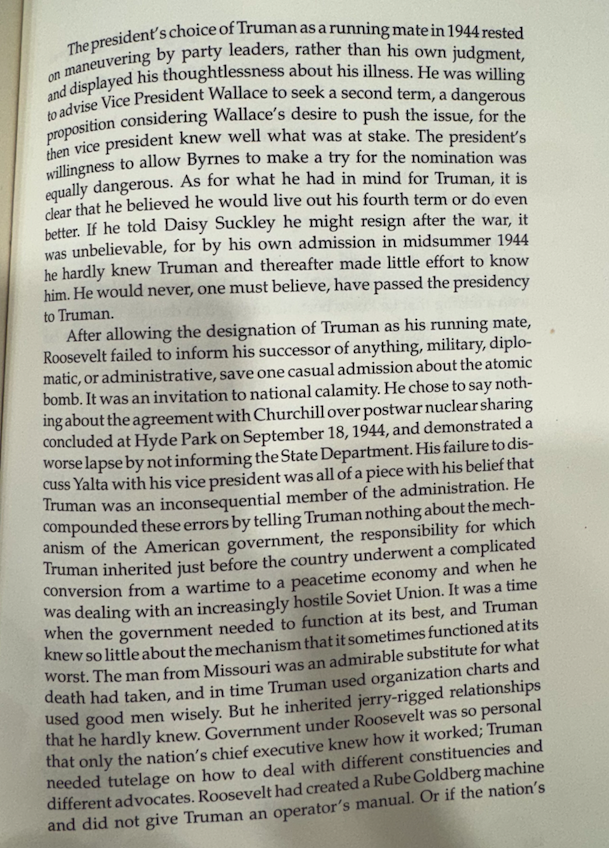
It's hard to say how much of this to read into the two geriatric presidents of our own time (although I was born during the Reagan Alzheimer's President years), the Trump/Biden/Trump days. Or rather it seems pretty easy to say the harms Biden is responsible for, among them allowing Trump to even be a candidate in 2024, but as far as Trump's relationship with his declining health and energy, should we wish for him to have more? How much evil is being prevented by naps? My suspicion is that when in power, he has Stephen Miller do his bidding, and when in naptime, Stephen Miller is the shadow president. So there isn't a lot of difference one way or the other. In the lame duck days, as they could have been in 1944, we're left to wonder whether we're better off with the Trump/Miller crew or whether "it happens" and then Vance is worse in some way. Can he hold MAGAworld together to keep the fun going, or like the New Deal, does it require a singular personality, suffering from clogged arteries and solipsism?